Before Your Baby Is Born
- Setting Up for Success: Ten Tips to Prepare for Breastfeeding
- Breastfeeding: 15 Ways New Dads can Help
- What to Bring with you to the Hospital
- What is Colostrum?
- Breastfeeding: The First Few Hours
- Breastfeeding: The First Three Days
- How your breasts will change during pregnancy and nursing
- Breastfeeding: What is a Latch?
- Breastfeeding: How to Position your Baby
- Breastfeeding: How to Hold your Breast
- Breastfeeding: How to Position Yourself
- Breastfeeding Holds: Cross-Cradle, Football Hold, Cradle, Side-Lying
- Breastfeeding: How to Know When Baby is Hungry (Rooting Reflex)
The First Six Weeks
- Breastfeeding: The First Six Weeks
- Breastfeeding and Nutrition: What should I eat while breastfeeding?
- Breastfeeding: Where to Find Support
- Breastfeeding: How to Latch
- Breastfeeding: What a Good Latch Feels Like
- Breastfeeding: How to Know if you Have a Good Deep Latch
- Care Plan: What to do if Your Baby Won’t Latch
- Care Plan: How to Use a Nipple Shield
- Breastfeeding: How Your Baby Gets the Milk Out of Your Breast
- Breastfeeding: How Often do I Breastfeed?
- Breastfeeding: How to Learn Baby's Feeding Cues
- Breastfeeding: How Long Should a Feeding Take?
- Care Plan: What if Early Breastfeeding is Not Going Perfectly?
- Breastfeeding: How do I Know Baby is Getting Enough at Each Feeding?
- Breastfeeding: How to Breastfeed a Sleepy Baby
- Care Plan: What to Do if Your Baby is Not Getting Enough at Each Feeding
- Breastfeeding: Waking Your Baby to Eat: When do I Stop?
- Breastfeeding: How to Know Baby is Getting Enough Overall - Diapers
- Breastfeeding: How to Know Baby is Getting Enough Overall - Weight Gain
- Breastfeeding: How to Know Baby is Getting Enough Overall - Infant Behavior
- Care Plan: What to Do if Your Baby is Not Getting Enough Overall
- Care Plan: Engorgement
- Care Plan: Sore Nipples
Finding Your Breastfeeding Rhythm
- Care Plan: How to Increase Your Milk Supply
- Increasing Your Milk Supply: What to Expect When Following the Care Plan
- Effective Feeding: What is it?
- Increasing Your Milk Supply: Why the Care Plan Will Work
- Effective Feeding: How to Identify Effective Feeding
- Effective Feeding: The Difference Between a Suck and a Swallow
- Effective Feeding: How to Ensure Effective Feeding
- Breastfeeding: Milk Flow - The Difference Between Breast and Bottle
- Breastfeeding: How Milk Supply Affects Your Flow Rate
- Care Plan: How to Fix Your Milk Flow and Increase Your Milk Supply
- Breastfeeding: Why Your Baby May Not Be Getting Enough
- Breastfeeding: What Am I Supplementing With?
- Plugged Ducts
- Mastitis
- Demystifying Cluster Feeding: What’s Normal...What’s Not
Common Challenges
- Getting Breastfeeding Support from Mom
- Care Plan: How to Increase Your Milk Supply
- Care Plan: What to do if Your Baby Won’t Latch
- Care Plan: Engorgement
- Care Plan: Sore Nipples
- Care Plan: How to Use a Nipple Shield
- What to Expect When Following the Care Plan to Increase Supply
- Care Plan: What to Do if Your Baby is Not Getting Enough at Each Feeding
- Care Plan: What to Do if Your Baby is Not Getting Enough Overall
- Why Your Baby May Not Be Getting Enough at the Breast
- Care Plan: Plugged Ducts
- Care Plan: Mastitis
- Care Plan: Yeast
- Care Plan: What if Early Breastfeeding is Not Going Perfectly?
Breastfeeding and the Working Mom
The Man Behind The Milk
Resource Library
Our Experts
Breastfeeding: How to Hold your Breast
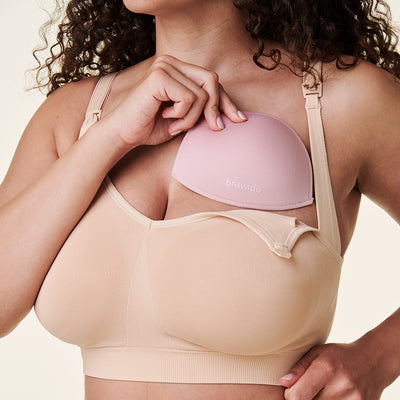
Whether you're a 32B or a 46H, it's helpful to support your breast in a way that will make it easy for your baby to get a good, deep latch. And by "support" we don't mean holding your breast up; instead, you'll learn to control and guide the front third of your breast—the areola and nipple area—so you can easily place it in your baby's mouth when she's ready to latch on.
The best way to visualize holding your breast is to imagine you're holding a small sandwich for your baby to bite. Just as you'd press a large sandwich down to fit into your mouth, you'll compress your breast to fit your baby's mouth.
And remember to watch your fingers. You'll want them close enough to control the front of your breast but not so close they'll get in the way.
Start by supporting your breast in a "U" hold, not a "C" hold. In other words, your thumb and forefinger are at the right and left of your breast as opposed to at the top and bottom. Your fingers should be just behind the border of the areola. Any closer might interfere with your baby's lower jaw, which needs to be latched deeply on the breast. Your thumb should be right next to the nipple. Push your thumb into your breast so the nipple points outward, away from your baby's mouth. It will look like you're offering her a "folded" breast, with her mouth poised to latch onto the areola, not the nipple. With your breast still firmly in the "U" hold, plant or "pin" her lower lip about an inch from the tip of the nipple, toward the border of the areola. When she begins to open her mouth wide, pull her onto your breast in one smooth motion, using your breast tissue as a tool to keep her lower lip pinned open and gently releasing your thumb to push the nipple into her mouth, clearing her top lip. Remember to bring her onto the breast and not to push your breast into her mouth.

This last action is the trickiest, so don't get frustrated if you can't get the hang of it right away. It takes some practice to learn to recognize when your baby is about to open her mouth wide.
Tips for success
- Support your breast in a "U" hold.
- Compress your breast in the same direction as your baby's mouth opens.
- Place your fingers behind the border of the areola and your thumb next to the nipple.
- Push your thumb into your breast so the nipple points outward.
Source: Heather Kelly is an International Board Certified Lactation Consultant (IBCLC) who also sits on the Bravado Breastfeeding Information Council. Heather has been practicing in New York City since 2001.
Related Articles
- Breastfeeding: How to Latch
- Breastfeeding: What a Good Latch Feels Like
- Breastfeeding: How to Know if you Have a Good Deep Latch
- Care Plan: What to do if Your Baby Won’t Latch
- Pumping: When Should I Pump?
- Pumping: Which Pump Should I Use?
- Pumping: How Do I Use a Breast Pump?
- Milk Storage: How Do I Store Pumped Milk?